

Description
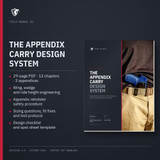
The Appendix Carry Design System: Field Manual 02
Appendix carry is the most demanding position to design for. This manual covers what makes an appendix holster conceal, stay comfortable seated, and stay safe at the moment that matters most: reholstering.
Revision 3.0, October 2026. Rewritten and independently audited, with design guidance tied to published maker and trainer sources, and Kobra house practice clearly labeled as such.
Who it is for
- Makers adding appendix (AIWB) holsters to their line
- Makers whose appendix designs print, pinch or ride wrong
- Anyone who wants a repeatable test and fit process
What is inside
- The appendix position: where the holster sits, body shape and muzzle direction
- Concealment geometry: how grip tuck really works, and what ride height and cant change
- The wing (claw): mount position, the common two-hole pattern and light-bearing cautions
- The wedge: fill vs. fulcrum, benchmark sizes and construction
- Forming for appendix: body-side contour, two-piece shells and sweat guard options
- Retention and reholstering: friction and interference designs, and a step-by-step appendix reholster procedure
- Advanced configurations: sidecars, belt-less systems and light-bearing appendix holsters
- Sizing and failures: sizing questions, the ten common design mistakes and what customer complaints really mean
- Testing and marketing: a four-phase test protocol and claims you can actually prove
- Appendices: design checklist, spec sheet template and sources
The details
- 29 pages, 13 chapters and 2 appendices
- 3 technical figures and 24 reference tables
- Instant PDF download, US Letter, print-ready, with linked contents and clickable sources.
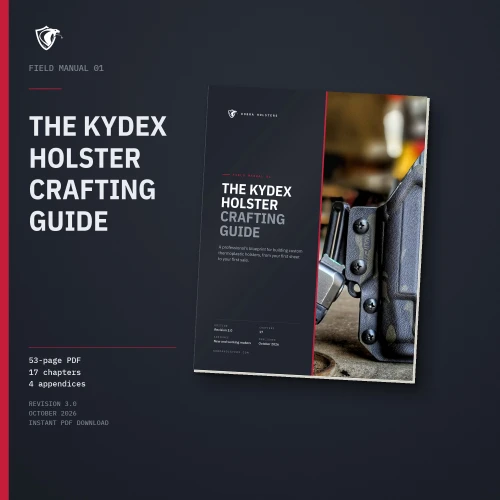
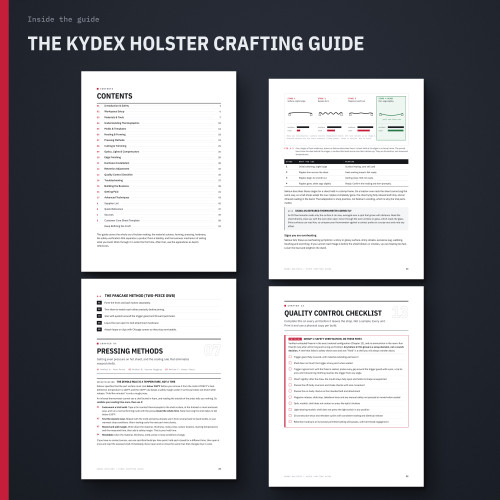
- Builds on The Kydex Holster Crafting Guide
From Kobra Holsters
Kobra Holsters has shipped more than 11,000 orders of handmade Kydex gear from our own shop. These guides are the working knowledge behind that, written up and checked against primary sources: material data sheets, platform policies and government rules.
Companion guides
This guide is for education and is not firearms training. All testing it describes is dry testing with no ammunition present.
File Details
- Format: PDF, US Letter
- Pages: 29
- Revision: 3.0, October 2026